If you distribute oxygen concentrators, your responsibility does not end when the shipment reaches your customer. Hospitals, clinics, homecare providers and equipment-rental companies will judge your business by how quickly you can keep their units operating when a filter is blocked, an alarm appears or a major component requires service.
A low unit price can lose its advantage quickly if your technicians do not have the correct service manual, calibrated test equipment or model-specific spare parts. Conversely, a planned after-sales system can reduce avoidable downtime, make warranty decisions easier and give your sales team a stronger reason to win repeat orders.
This guide shows you how to build that system: how to separate user care from technical maintenance, which parts to stock, how to estimate inventory, how to document each repair and what to request from your manufacturer before placing a bulk order.
1. Why Maintenance Planning Affects Your Distribution Business
Oxygen concentrators use pressure swing adsorption (PSA). The compressor supplies pressurized air, filters protect the air path, valves control the adsorption cycle and molecular sieve beds remove much of the nitrogen. The control board, sensors, fan, flowmeter and alarm system help the machine regulate and monitor operation.
Because these systems interact, the symptom your customer reports may not identify the failed component. Low oxygen concentration, for example, can be associated with restricted airflow, leakage, incorrect flow settings, compressor wear, valve problems, environmental conditions or loss of sieve performance. Replacing the sieve beds without testing the rest of the system may waste a part and leave the original fault unresolved.
For your distribution business, a maintenance plan protects four areas:
- Equipment availability: you can restore service faster when common parts and a swap unit are locally available.
- Warranty control: serial numbers, operating hours and service records help distinguish manufacturing defects from unsuitable operating conditions or unauthorized repairs.
- Customer retention: predictable support makes hospitals and dealers more confident about repeat purchases.
- Total service cost: planned filter supply, technician training and consolidated parts shipments are usually easier to budget than emergency international deliveries.
The WHO technical specifications for oxygen concentrators emphasize selection, utilization and maintenance as parts of the same equipment-management process. UNICEF’s target product profile also calls for spare-parts planning, oxygen-concentration measurement, pressure checks and trained technical support.
2. Who Should Perform Each Maintenance Task?
Your customers need a clear boundary between routine user care and technical service. If that boundary is vague, users may open equipment they are not qualified to repair, while technicians may be called for tasks that trained operators could safely complete.
| Service level | Typical tasks | Who should perform them | Your role as distributor |
|---|---|---|---|
| User care | External cleaning, checking vents, inspecting the power cord, managing the humidifier bottle and cleaning an accessible reusable external filter when the manual allows it | Trained operator following the model-specific user manual | Provide the manual, quick-reference instructions and user training |
| Preventive technical service | Performance checks, alarm tests, oxygen-concentration measurement, pressure checks, internal filter inspection and scheduled part replacement | Trained service technician | Provide training, test procedures, parts and service records |
| Corrective repair | Electrical diagnosis, leak testing, compressor or valve service, PCB replacement, sieve-bed assessment and post-repair verification | Qualified technician authorized under your service policy | Control repair authorization, technical escalation and warranty evidence |
| Factory escalation | Unresolved faults, repeated failures, safety-related complaints, design-level questions and regulatory reportability assessment | Manufacturer technical and quality teams | Send complete case data and preserve affected parts when requested |
3. How to Build an Oxygen Concentrator Preventive-Maintenance Schedule
Build your schedule from two triggers: calendar time and cumulative operating hours. A unit running 15 hours per day reaches a service threshold sooner than a lightly used backup unit, while a stored or rarely used unit still needs periodic functional and safety checks.
The following framework is for planning only. Replace it with the intervals and procedures in the applicable OLIVE or other manufacturer manual.
| Planning stage | Checks to include | Evidence to record |
|---|---|---|
| Before first delivery | Correct model, voltage and plug; exterior and packaging; accessories; serial number; power-on test; alarms and output within the manufacturer’s acceptance criteria | Incoming-inspection form, serial record and test result |
| At installation or handover | Ventilation clearance, clean location, electrical suitability, correct accessories, operator instruction and backup-oxygen plan | Commissioning checklist and signed training record |
| Routine user check | Visible damage, blocked vents, unusual sound, alarm state, humidifier condition when used and external filter condition | Local daily or pre-use checklist where required |
| Periodic preventive service | Operating hours, oxygen concentration at specified flow, outlet pressure where applicable, flow accuracy, alarms, temperature, noise, filter condition, leakage and electrical condition | Measured values, instrument IDs, technician and date |
| After repair | Root cause addressed, all connections secure, full functional test, oxygen concentration stabilized, alarms verified and exterior restored | Parts used, work completed and final acceptance results |
| Before redeployment | Cleaning/decontamination under approved instructions, accessory replacement, safety inspection and complete performance verification | Redeployment-release record |
UNICEF’s oxygen concentrator target product profile discusses weekly cleaning of accessible external coarse filters in its reference framework and recommends more frequent user care in very dusty conditions. It also notes that preventive-maintenance frequency should follow the manufacturer’s recommendation and include alarm, pressure and oxygen-concentration checks. These points are useful for procurement planning, but they do not override your model manual.
What your technicians should measure
- Oxygen concentration after the specified warm-up or stabilization period
- Flow at the test point required by the service procedure
- Outlet or internal operating pressure where the procedure requires it
- Power-failure and other accessible alarm functions
- Operating temperature and abnormal noise where relevant
- Supply voltage and electrical condition
Record actual values, not simply “pass.” Trend data may reveal gradual deterioration before a customer reports failure. Ensure measuring equipment is suitable, maintained and calibrated at the required interval.
4. Which Oxygen Concentrator Spare Parts Should You Stock?
Your stock should be organized by model and service level. Parts that look similar may have different dimensions, electrical ratings, connectors, software or performance characteristics. UNICEF specifically notes that oxygen concentrator parts are not necessarily interchangeable between brands and models.
Tier 1: User-replaceable consumables and external items
- Model-specific external intake filters or filter media
- Internal filters only when replacement is permitted at the assigned service level
- Humidifier bottles and compatible connectors where applicable
- Power cords with the correct plug and electrical rating
- Approved tubing adaptors and outlet fittings
- Fuses or alarm batteries when the model uses replaceable versions
These are usually the fastest-moving items and should be included in customer quotations when predictable replacement is required. Patient-use accessories such as cannulas and masks are not the same as equipment spare parts; manage them according to local infection-control rules and their instructions for use.
Tier 2: Common technician-replaceable service parts
- Compressor service components or approved compressor assembly
- Motor capacitors
- Solenoid or electronic valves
- Cooling fans
- Flowmeters and outlet assemblies
- Pressure regulators or sensors where model-specific procedures allow replacement
- Wheels, handles, covers and hardware subject to transport or handling damage
Tier 3: Lower-frequency, higher-value assemblies
- Molecular sieve-bed assemblies
- Main control boards and display boards
- Complete compressor assemblies
- Valve manifolds or integrated gas-path assemblies
- Oxygen sensors where replaceable and specified
Do not treat sieve beds as routine consumables with one universal replacement time. Their condition may be affected by operating hours, moisture, contamination, leakage and compressor or valve performance. Confirm low concentration with an appropriate analyzer and complete the manufacturer’s diagnostic process before replacement.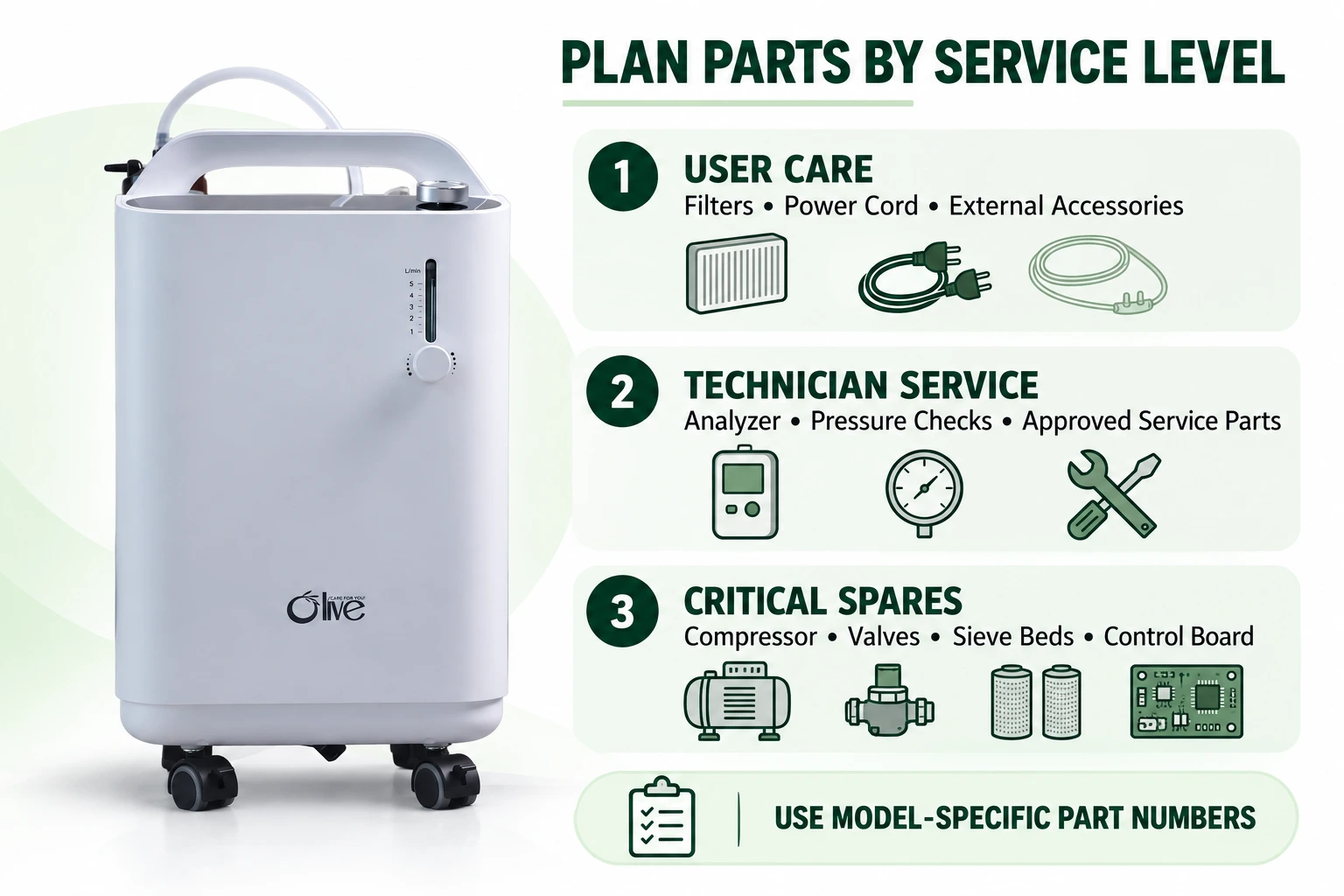
5. How Much Spare-Parts Inventory Do You Need?
There is no responsible fixed percentage for every distributor. Your stocking level should reflect the installed base, failure and consumption history, supplier lead time, customs delay, service commitment and the clinical importance of the customers you support.
For a scheduled filter, you can estimate expected demand from the number of installed units and the model’s replacement schedule. For corrective parts, begin with the manufacturer’s recommended starter kit, then revise quantities using your own service data.
| Factor | Questions to ask | Inventory implication |
|---|---|---|
| Installed base | How many units of each exact model are active? | Track parts by model, not only by total units sold |
| Utilization | Are units used occasionally, daily or continuously? | Higher-hour fleets may consume filters and wear parts faster |
| Environment | Are sites dusty, hot, humid or at high altitude? | You may need more frequent inspections and greater local stock |
| Lead time | How long do production, export, customs and domestic delivery take? | Long or variable lead times require more safety stock |
| Service promise | Do you promise same-day exchange, 48-hour repair or depot service? | Faster commitments require parts and possibly complete swap units |
| Part criticality | Will the failure stop oxygen output or only affect convenience? | Prioritize parts that cause complete loss of function |
| Warranty exposure | Which models and serial ranges remain under warranty? | Separate warranty stock and obtain replenishment rules in writing |
UNICEF’s reference specification calls for a clearly itemized parts package and discusses enough filters for two years of operation at 15 hours per day, together with items such as a power cord, fuses and alarm battery where applicable. Use this as a procurement benchmark—not as a universal OLIVE kit—because the correct contents must match your selected model, quantity and operating plan.
Use ABC and criticality classification
- A-critical: parts whose absence can keep a unit out of service, such as a compatible compressor, sieve assembly, control board or valve assembly.
- B-planned: scheduled filters and commonly replaced service parts with predictable usage.
- C-convenience: lower-cost exterior parts and accessories that do not usually determine core oxygen performance.
Review stock quarterly at first. Track parts used per 100 installed units, average repair turnaround, repeat repairs and stockout days. After you have reliable local data, you can set model-specific reorder points instead of relying on a generic kit indefinitely.
6. How Should Your Team Diagnose Common Symptoms?
The table below is a triage guide, not a repair instruction. Your technician must use the current service manual, disconnect power where instructed and complete post-repair verification before releasing the equipment.
| Reported symptom | Initial checks | Possible technical areas | Do not assume |
|---|---|---|---|
| Unit will not start | Correct voltage, outlet, cord, switch, external protection and visible damage | Fuse, wiring, power supply, PCB or compressor circuit | That the control board has failed before checking the supply |
| Low oxygen concentration | Correct flow setting, warm-up time, analyzer status, filters, ventilation and leaks | Compressor, valves, tubing, pressure, sensor or sieve beds | That sieve replacement alone will solve the problem |
| Low or unstable flow | Tubing obstruction, humidifier connection, flowmeter setting and leakage | Flowmeter, valve, compressor, regulator or gas-path restriction | That the displayed flow equals independently verified output |
| Overheating or shutdown | Ventilation clearance, ambient temperature, dust, fan operation and supply voltage | Cooling fan, compressor load, electrical protection or internal blockage | That repeated thermal shutdown is normal |
| Unusual noise or vibration | Placement, loose exterior parts and transport damage | Compressor mounts, piston components, fan or valve operation | That normal oxygen output means the sound can be ignored |
| Frequent alarm | Record exact alarm code, operating conditions and time to alarm | Depends on model: concentration, pressure, temperature, power or sensor circuit | That alarm codes mean the same thing across models |
OLIVE publishes a troubleshooting guide covering common symptoms, including power, flowmeter, noise, low-concentration and alarm issues. Use it with the exact model manual and technical support; do not apply a web summary as a substitute for an authorized repair procedure.
When should you remove a unit from service?
Remove and label the unit according to your service policy when it cannot meet specified oxygen concentration or flow, presents damaged electrical parts, repeatedly overheats, produces an unresolved alarm, shows evidence of liquid ingress or has undergone an unauthorized internal repair. Provide the customer with the planned backup source or swap unit instead of returning unverified equipment to use.
7. What Tools and Records Does Your Service Workshop Need?
Core test and service equipment
- A suitable, calibrated oxygen analyzer
- Flow measurement equipment appropriate to the model range
- Pressure gauge and approved adaptors where required
- Electrical test equipment used by trained personnel
- Leak-test equipment and manufacturer-approved method
- Model-specific tools, fixtures and service software where applicable
- Cleaning materials compatible with manufacturer instructions
- ESD protection when working on electronic assemblies
Minimum service record
- Customer, location, model and serial number
- Cumulative operating hours
- Complaint, alarm code and operating conditions
- Incoming oxygen concentration, flow and pressure readings as applicable
- Diagnostic steps and identified cause
- Part numbers, quantities and batch or source where required
- Warranty or chargeable-service decision
- Final measured performance and alarm test
- Technician, date and customer handover
A consistent fault code list helps you convert service history into purchasing decisions. Instead of recording “repaired,” use defined categories such as blocked filter, damaged cord, transport damage, compressor wear, valve fault, gas leak, PCB fault, environmental issue or no fault found.
8. What Should You Request From the Manufacturer?
Do not wait for the first breakdown to discover that you lack a parts diagram or that a component has several versions. Complete the after-sales package before your bulk order ships.
- Current user manual and technician service documentation
- Exploded view or part-location diagram where available
- Model-specific spare-parts list with part numbers, photos and compatibility notes
- Recommended initial kit for your order quantity and expected operating hours
- Preventive-maintenance schedule and acceptance criteria
- Alarm-code and troubleshooting information
- Required test equipment, adaptors and tools
- Training format and assessment for your technicians
- Warranty terms, exclusions and claim procedure
- Rules for returning, retaining or disposing of failed parts
- Parts lead time, minimum order quantity and expected availability period
- Change notification when a part or design revision affects compatibility
OLIVE’s quality-management page describes documented controls from incoming inspection through production and final release, including a 48-hour aging test and checks of oxygen concentration, flow, pressure, temperature, noise, alarms and safety functions. Its Download Centre also provides selected model manuals and brochures.
These public resources are useful for initial evaluation, but your distributor agreement should still define the exact manuals, training, spare-parts package and response process available for the models you purchase.
Questions that reveal whether support is operational
- Can the supplier map every spare part to the quoted model and voltage version?
- Will the supplier review your proposed starter stock against your installed-base plan?
- Can your technicians receive remote diagnostic support using serial number, readings, photos and video?
- How are warranty parts approved and replenished?
- What happens when a component is revised or discontinued?
- Can major assemblies be consolidated with your equipment shipment?
9. What Should You Include in Your Maintenance and Spare-Parts RFQ?
A good RFQ allows the manufacturer to recommend parts based on your business, not just attach a generic price list.
- Destination country and service territory
- Exact concentrator models, voltage versions and quantities
- Customer type: hospital, clinic, homecare, rental, veterinary or other channel
- Expected operating hours and environmental conditions
- Number and skill level of technicians
- Your promised repair or swap turnaround
- Expected replenishment frequency and preferred shipping method
- Two-year consumables estimate or another period matching your contract
- Recommended corrective-maintenance kit
- Part number, description, compatible models, unit price and MOQ
- Estimated replacement or usage basis—not an unsupported universal lifespan
- Required tools and technician level
- Warranty stock and replenishment procedure
- Production and shipment lead time
- Availability of swap units or complete replacement assemblies
RFQ template you can send
We plan to distribute [quantity] units of model [model/voltage] in [country] to [customer type]. Expected use is approximately [hours] per day in [temperature/dust/humidity/altitude] conditions. We will support an installed base of [quantity] units with [number] trained technicians and a target service turnaround of [time]. Please provide a model-specific preventive-maintenance schedule, user and service manuals, recommended two-year consumables, corrective-repair spare-parts kit, part numbers, compatibility, required tools, technician training, warranty-parts procedure, MOQ, prices and replenishment lead times.
10. Your Distributor Maintenance Checklist
- Create a serial-number register for every unit sold.
- Keep the correct manual and parts revision linked to each model.
- Define which tasks users, local technicians and the manufacturer may perform.
- Commission units and train customers before normal use.
- Schedule service by calendar time and operating hours.
- Measure oxygen concentration with appropriate calibrated equipment.
- Stock model-specific consumables and critical parts.
- Maintain backup or swap capacity for customers whose operations cannot wait.
- Record fault causes, parts used, turnaround time and repeat repair rate.
- Review parts forecasts and technician training with the manufacturer regularly.
Frequently Asked Questions
How often should an oxygen concentrator be serviced?
There is no universal interval for every model. Follow the model-specific user and service manuals, using both calendar time and operating hours. Dust, heat, humidity, utilization and local requirements may justify more frequent inspection.
How often should oxygen concentrator filters be replaced?
It depends on filter type, model, environment and manufacturer instructions. Some accessible filters may be cleaned; others must be replaced and should not be washed. Confirm the part number and procedure before supplying a replacement.
When should molecular sieve beds be replaced?
Replace them only after model-specific diagnosis indicates that the sieve assembly no longer meets required performance or when the manufacturer’s procedure requires it. Low oxygen concentration can also result from airflow restriction, leakage, compressor wear, valves, incorrect flow or test conditions.
What are the most important oxygen concentrator spare parts for distributors?
Common categories include filters, power cords, fuses or alarm batteries where applicable, compressor service parts, valves, fans, flowmeters, capacitors, sieve-bed assemblies and control boards. The correct list depends on the exact model and your authorized service level.
Can spare parts from different concentrator brands be interchanged?
Do not assume so. Similar-looking parts may differ in rating, dimensions, connectors, control logic and validated performance. Use manufacturer-confirmed parts for the exact model and revision.
What equipment is needed to test an oxygen concentrator after repair?
Typical requirements include a suitable calibrated oxygen analyzer, flow measurement equipment, pressure gauge where applicable and electrical or leak-test equipment used by trained technicians. The manufacturer should specify the exact tools and acceptance criteria.
Should a distributor keep complete replacement units?
Possibly. Swap units can be more effective than stocking every major assembly when customers require rapid continuity. The right quantity depends on clinical risk, installed base, repair turnaround, transport time and the customer’s backup-oxygen arrangement.
What information should be sent with a technical-support request?
Send the model, serial number, operating hours, voltage version, complaint, alarm code, environment, flow setting, measured concentration and pressure where applicable, service history, photos and a clear video. Complete information reduces repeated questions and speeds diagnosis.
Build After-Sales Support Before You Build Volume
Your most valuable maintenance asset is not a warehouse full of random components. It is a controlled system connecting installed units, trained technicians, current documentation, calibrated measurements, model-specific stock and fast manufacturer escalation.
When evaluating an oxygen concentrator supplier, compare more than product price and headline specifications. Ask how your team will diagnose faults, which parts should ship with the initial order, how warranty stock is replenished and how the supplier will support you as the installed base grows.
If you are evaluating OLIVE for a wholesale, distribution or OEM project, review the medical oxygen concentrator range and send us your selected models, quantity, destination market, expected operating hours and service capability. We can then confirm the model-specific technical documents and available spare-parts support for your project.
- WHO: Technical Specifications for Oxygen Concentrators
- UNICEF: Target Product Profile for Oxygen Concentrators
- WHO–UNICEF: Technical Specifications and Guidance for Oxygen Therapy Devices
- WHO: Medical Equipment Maintenance Training Resources
- OLIVE: Oxygen Concentrator Quality Management
- OLIVE: Oxygen Concentrator Troubleshooting Guide
- OLIVE: Product Manuals and Download Centre
This article is intended for distributor procurement and service planning. It does not replace the current model-specific user manual, service manual, technician training, clinical backup planning or applicable local regulations.
Request a Model-Specific Spare-Parts Plan
Tell us your target models, order quantity, destination country, expected daily operating hours and local service capability. The OLIVE team can help you review suitable concentrators and confirm available manuals, training and spare-parts options for your distributor project.
Request a Distributor Quote and Parts List